Benoit Mandelbrot is the father of fractals. He is one of a the rare geniuses that no one takes issue with calling a genius. He was a child prodigy known for being able to visualize math problems and turn them into simple geometric ones. He is a polymath that contributed to a wide variety of domains; economics, mathematics, geography, art and beauty, fluid dynamics, and computing. Despite the seeming discontinuity of these fields, Benoit found a common thread. The way he tied all of these fields together was with his self-given title: “Fractalist“.
Mandelbrot coined the term Fractal in 1975 to describe the new category of math he was pioneering. He invented a new category of math in the 1970s.(1)
No matter how I write that sentence, I can’t make it carry the weight it should. He INVENTED a NEW CATEGORY of MATH in the 1970s. Inventing a new category of math is insane. Geometry, calculus, and trigonometry have been well established for hundreds and thousands of years They have had innovations and discoveries since their inceptions, but they fall within an existing category. Benoit made a new category. In the 1970s. Einstein worked out the theory of relativity in the 1910s. One of the most revolutionary and counterintuitive ideas of Physics preceded an entire category of math. This would be wild even if Fractals were insignificant, but this category is fundamental for understanding nature, disorder, and the abstract. In other words: It is fundamental for understanding life.
What is a Fractal?
To understand how significant fractals are, we first need to answer the question: what is a fractal? The The Fractal Foundation gives this definition:
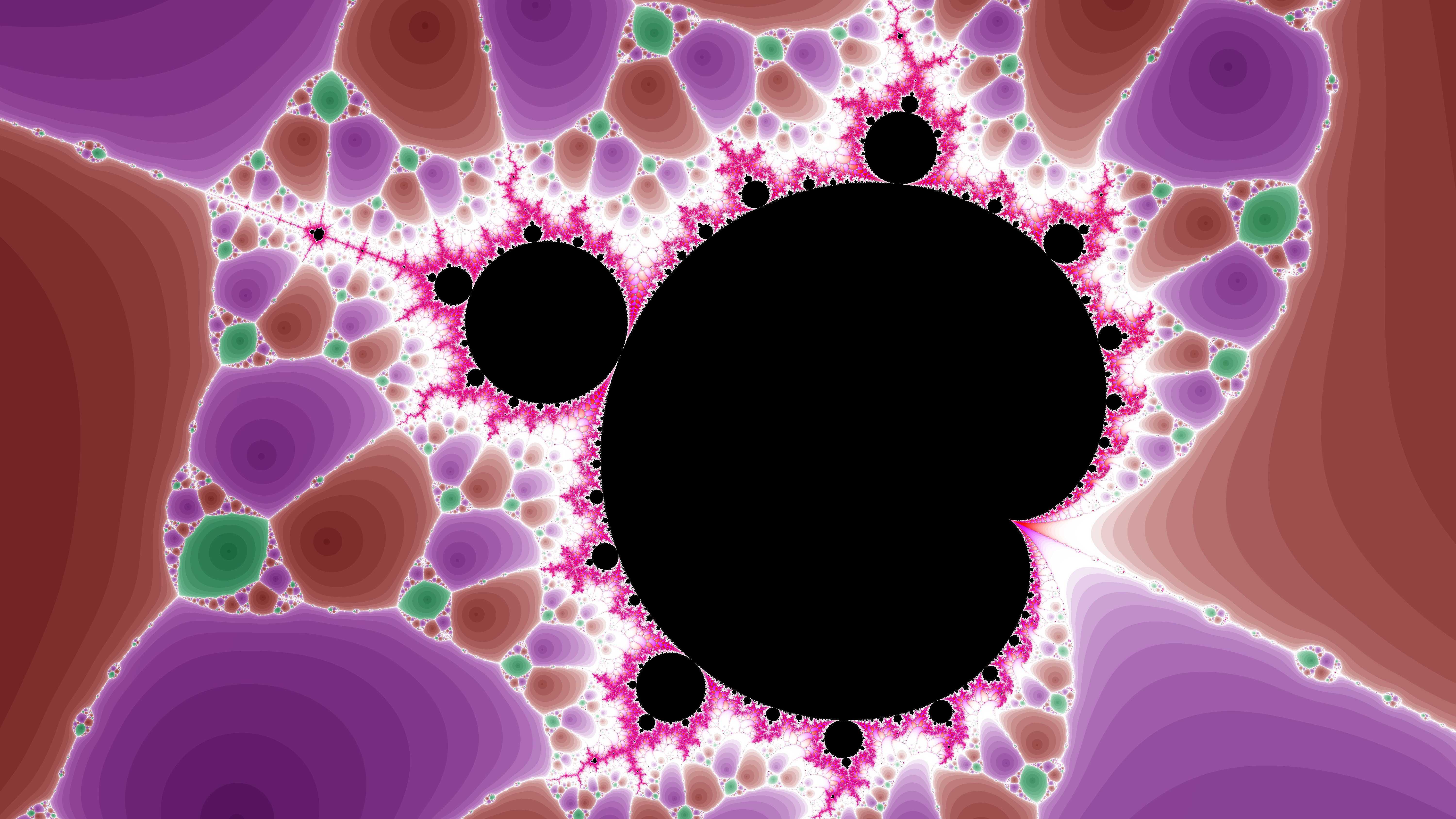
A fractal is a never-ending pattern. Fractals are infinitely complex patterns that are self-similar across different scales. They are created by repeating a simple process over and over in an ongoing feedback loop…
…Fractal patterns are extremely familiar, since nature is full of fractals. For instance: trees, rivers, coastlines, mountains, clouds, seashells, hurricanes, etc. Abstract fractals – such as the Mandelbrot Set – can be generated by a computer calculating a simple equation over and over.
– The Fractal Foundation
*Emphasis mine
Fractals are self-similar patterns created by repeating a simple rule.
Self-similar means that a piece of the whole looks like the whole. Take a tree for instance. Each branch of a tree looks like a smaller version of the whole tree, and those branches break up into smaller branches, into smaller limbs, into smaller offshoots, into leaves. Every branch looks somewhat like the whole. If you planted a branch (and took care of it), it would even grow into it’s own tree. The pattern of the veins on the leaf looks similar to the pattern of the tree as a whole. This self-similarity, the ability to zoom in and zoom out and see the same patterns, is what defines a fractal.
The simple rule of a tree is to split and explore. A seed will shoot a growth into the air and roots into the ground. Each side will grow a little bit, then split, then grow a little bit more, then split. On and on. The tree explores it’s environment in this way. Much like how humans have explored new lands and settled around rivers and natural resources, the tree will explore and grow towards the resources it needs. It will maximize for sun and CO2 exposure above the ground and nutrients below. This behavior is more obvious indoors where resources are scarce. Houseplants grow towards the only place to get the important resource of light: windows.
Fractals Everywhere
Once you can see what fractals looks like, you will start seeing them everywhere. When you zoom into a seashell, the zoomed-in spiral looks like the whole spiral. Each branch of a river looks like a little river itself.
We are in a universe populated by large clusters of galaxies, which are made up of individual galaxies, which are made up of solar systems, which are made up of celestial objects, which are made up of large clusters of chemicals, which themselves are clusters of molecules, which are clusters of atoms, which are made up of fundamental particles like electrons and leptons and quarks.
Some physicists think that inside of a black hole, you will find another universe with blacks holes. And in those black holes, other universes with black holes. Infinitely fractaling down. When you zoom in, you see something similar to when you zoom out.
Even the non-physical structures of the natural world are fractal. We homo sapiens are a part of the natural world and we structure everything in our society in fractal patterns.
Art and culture have fractal elements. The art of Jackson Pollack is so fractal in nature that frauds can be distinguished from authentic works with fractal analysis. Fractal patterns have been ubiquitous in architecture throughout history from all parts of the globe. It is not uncommon for distracted students to sketch fractal patterns in their notebooks without realizing what they are doing.
Companies are made up of departments, which function like little-companies inside the company. Departments are made up of teams, which function like little departments, which are made up of employees, which function like little companies themselves. Companies make up industries, industries make up an economy.
Families are like a little community. They are supposed to teach their members the rules for interacting in the family and in the community. Communities make up cities, cities make up states, states make up countries. All with their own similar rules and similar patterns. The global community is one big fractal pattern.
Fractals are being used to model the world and solve actual technical problems. Scientists are working to develop working retinal implants based on the idea that neurons are fractal in structure. Mandelbrot, the man himself, used fractals to model the stock market more accurately. Video games, movies, and photo-editing software use fractal generators to create natural landscapes in a small file size. A google-scholar search for “Fractals” will populate papers from almost every domain of knowledge.
So What?
So there are a lot of examples of fractals in life, and they do seem like an ever-present structure, but why is this useful?
The main idea of this blog is “Life is a Fractal Pattern”, and I have two reasons for that:
- It allows me to write about anything I want. If I make the claim that life is fractal, then it is self-similar. If it is self-similar, then you can look at any piece of life and find out things that are true about all of the other pieces of life and life as a whole. I think this is true, but it is also useful for my self-indulgent desire to write about anything I find interesting. With the Fractal Analogy, I can reliably shoehorn any topic into a unified body of work.
- I want to make sense of infinite complexity. Life is infinitely complex, and it can feel paralyzing. How can we make decisions in a world that is constantly evolving and changing and becoming more and more complicated? If life is fractal, then that infinite complexity can be distilled to simple rules and processes that are repeated over and over. While I think this is literally true, it is at least useful. We can’t operate in the world without simplifying it. Maps are only useful because they are simplified versions of the real thing.
And a map is a good analogy. Whether you are consciously aware of it or not, we all have a mental map that we use to navigate the world. The better your map, the better you can navigate. An accurate map can keep you from stubbing your toes and help you make better decisions and choices. It can help get you where you want to go. Fractals might be fundamental to the way reality is structured, but at a minimum they are a good tool for mental mapmaking. They can help you think between mental models at different scales and varied domains. They can help understand patterns and make chaos seem a little less daunting.
This blog is going to be a random assemblage of thoughts about mental mapmaking, worldview, philosophy, pattern, and action. The end goal is to pass a feeling. Sometimes I feel stuck. I feel like I am navigating alone in the dark. Like I can’t sense the right direction and can’t see my hand in front of my face. When I write and think through these ideas, I don’t feel that way. Writing sheds a little light on my experiences. I can see the path, I can see other people, I can take steps, and I can move forward. I am sure you are on your own path, but if I can pass this feeling, we can walk together.
(1) – It’s not exactly 100% fair and accurate to contribute Fractals to Benoit exclusively. Others contributed to the field and were working on it simultaneously to Benoit. Ancient civilizations even used fractals in their art, but knowing how to catch a ball is not the same as discovering the equations of motion. Benoit is widely acknowledged as the father of fractals and had the largest contributions to the field.
(2) The Mandelbrot Set Explained – by numberfile. The best explanation I’ve found.
(3) The fear of asking for help is unfounded. Therapy is great. Despite my analogy, you really aren’t on the path alone. More people feel this way than they let on, and I’ve been surprised by how much better it gets talking to friends and family.

 Fractal Forward